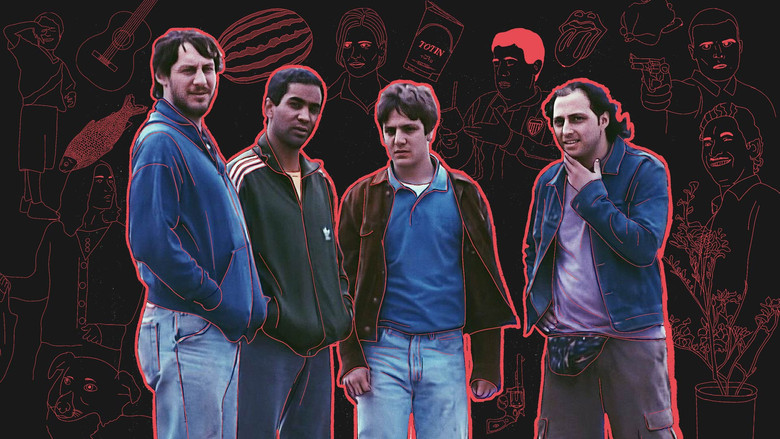

Very few shows have shaped Argentine popular culture the way Okupas has. Conceived and helmed by Bruno Stagnaro, this brief crime drama debuted in 2000 and swiftly earned its place as a touchstone thanks to its honest, hard-hitting depiction of youth living at society's margins. Twenty years on, it still stands as a benchmark for Latin American television, celebrated for its authenticity and for the acting careers it set in motion.
The Premise: What Okupas Is About
At the center of Okupas is Ricardo, a young man raised in a middle-class household whose path changes dramatically once he crosses paths with three other youths: El Pollo, Walter and El Chiqui. What unites them is a crumbling old house in Buenos Aires, which they occupy and transform into a shared home.
From that squat, the four form a deep friendship while drifting through petty crime, drug use and life on the outskirts of society. The show refuses to glamorize their situation; it watches their everyday struggles with a patient, almost documentary eye, allowing the neighborhood to function as a character in its own right.
The series' enduring strength lies in the conflict between loyalty and survival. The friendship among the four is real and often touching, but their surroundings continually put it to the test, forcing each of them toward hard and sometimes permanent decisions.
Episode Count and Season Format
Okupas aired as one season made up of eleven episodes, each running about forty minutes. It broadcast from October through December 2000, wrapped up that same year, and no further seasons followed.
The compact shape serves the show well. With under a dozen installments, the narrative remains lean and focused, every episode pushing the group's story forward instead of stretching it. The forty-minute episodes allow the drama to develop while maintaining momentum, and the season moves steadily toward a definite ending rather than leaving loose ends.
Since it was built as a self-contained, one-season tale, Okupas is a simple commitment for today's audiences. A weekend is enough to finish it, though its richness and atmosphere repay a slower, more careful watch.
Cast and Characters
The core of Okupas rests on its four leads. Rodrigo de la Serna portrays Ricardo, the middle-class youth whose joining the group sparks the story. Diego Alonso appears as El Pollo, Ariel Staltari plays Walter, and Franco Tirri takes the part of El Chiqui. The four performers generate a believable chemistry that holds the whole series together.
Surrounding the central four is a strong supporting lineup: Ana Celentano as Clara, Rosina Soto as Sofía, and Dante Mastropierro as El Negro Pablo. Sergio Podeley plays El Mulo, Jorge Sesán plays Miguel, and Claudio Rissi appears as the Fletero, a part that has grown into one of the show's most memorable figures.
The series also stands out as an early showcase for Rodrigo de la Serna, who later became one of Argentina's best-known actors. His work here ranks among the defining performances of his career, and the ensemble's naturalistic approach helped define the show's overall look and feel.
Behind the Camera: Creation and Production
Bruno Stagnaro both created and directed Okupas, defining its concept and its visual character. His method put realism ahead of convention, using the texture of Buenos Aires street life to anchor the drama in a believable social world.
Cinematographer Juan Cruz Bucich was essential to establishing the series' aesthetic. The camerawork leans toward a gritty, hand-held immediacy that was pioneering for Argentine television at the time, lending the show the feel of urban cinema rather than standard TV fare.
Ideas del Sur, one of the country's leading production houses, produced the series, which aired on Televisión Pública Argentina. The pairing of a public broadcaster, a socially charged subject and an auteur director made Okupas a rare proposition for its moment, and its popularity proved that local viewers wanted drama drawn from their own streets.
Broadcast History and Lasting Influence
Okupas first aired on October 18, 2000, with its last episode broadcast on December 27 that year. The show is formally classified as ended, and its lone season of eleven episodes constitutes the full story.
Short as its run was, the series' impact has lasted far past its original airing. It is regularly named a milestone of Argentine television, credited with confronting urban marginalization in ways mainstream programming had mostly sidestepped. Its mix of crime storytelling and social realism helped clear the path for the more ambitious domestic drama that came after.
Audiences have kept faith with the show as well, as shown by its strong 8.6 rating, an impressive score that reflects how well the series continues to resonate with new viewers.
Tone, Themes and Visual Approach
At heart, Okupas examines friendship under strain. The four protagonists share loyalty, humor and a powerful feeling of belonging, and much of the show's emotional force comes from seeing those ties tested by poverty, addiction and the ever-present danger of violence.
The tone is blunt and frequently grim, yet it carries moments of warmth and wry humor. Stagnaro's direction steers clear of moralizing; the characters are not heroes or warnings, just young people attempting to claim a place for themselves. Drugs, crime and the instability of squatting are shown plainly, without embellishment.
Visually, the series embraces the textures of Buenos Aires: tight interiors, crowded streets and the worn elegance of the old house at the story's center. That tangible realism, joined with the naturalistic acting, gives Okupas a documentary urgency that still feels powerful today.
Who Should Watch Okupas
Okupas suits viewers who gravitate toward grounded crime stories and social realist drama. Admirers of Latin American film and television, especially gritty urban narratives, will find plenty to value in its honesty and craft.
It also speaks to anyone curious about television history, as the series is broadly seen as a turning point for Argentine drama. Be ready for adult content, including portrayals of drug use and crime, presented with realism rather than polish.
Since the show is in Spanish and deeply rooted in its Argentine setting, viewers who like subtitled international programming will benefit most. Anyone wanting a tight, finished story rather than an open-ended saga will appreciate its single-season design.
Where to Watch Okupas
Okupas was first broadcast on Televisión Pública Argentina, the nation's public channel. For audiences in the United States, the series can be found on streaming services, opening it up to international viewers encountering it for the first time.
As a complete, standalone season of eleven episodes, it can be finished quickly. Consulting current streaming listings is the surest way to check availability where you live, since platform catalogs shift over time.
Considering its stature and lasting reputation, the series stands among the most rewarding imports from Argentine television, and with US streaming access, this landmark drama is now easy to track down.
Frequently asked questions
How many episodes of Okupas are there?
The show ran for one season totaling eleven episodes of roughly forty minutes each. It broadcast between October and December 2000 and was conceived as a finished, standalone story with no follow-up seasons.
Who created and directed Okupas?
Bruno Stagnaro created and directed the series, with Juan Cruz Bucich serving as cinematographer. Ideas del Sur produced it, and it originally aired on Televisión Pública Argentina in 2000.
Who plays Ricardo in Okupas?
Rodrigo de la Serna takes the role of Ricardo, the middle-class young man at the story's heart. The part marked an early high point in his career, and he appears alongside Diego Alonso, Ariel Staltari and Franco Tirri, the other three leads.
Is Okupas in English?
No. Okupas is an Argentine production filmed in Spanish. Viewers abroad, including in the United States, usually watch it with subtitles, which keeps the naturalistic acting and local character of the dialogue intact.
Was Okupas renewed for a second season?
No. Its eleven episodes aired in 2000 and the series is officially marked as ended. The one season delivers a complete narrative, which helps make it such an approachable watch for newcomers.





















Comments (0)
Log in or create a free account to comment, rate and write reviews.