
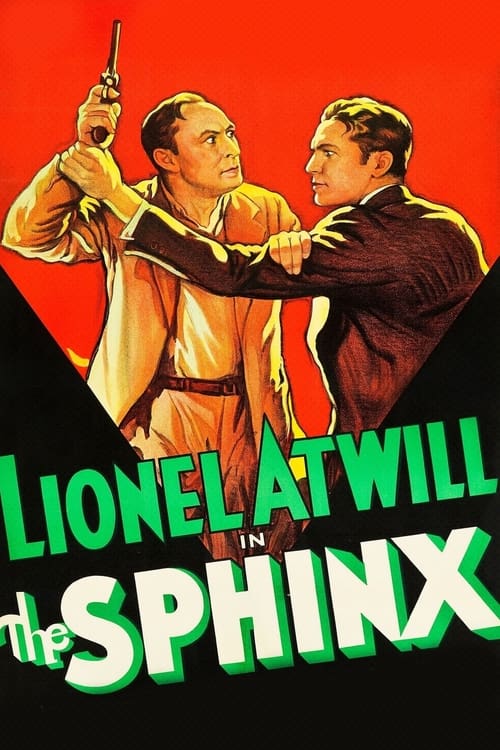


Plenty of crime stories ask who did it. The Sphinx, a compact 1933 pre-code thriller, asks something far odder: how the deed could have been done at all. Its central figure is a man who cannot talk, yet everyone who watched him hurry from a killing recalls hearing his voice. From that one impossibility, the picture spins sixty-four minutes of brisk, shadowy fun.
The Premise: A Suspect Who Cannot Speak
On paper, the hook is straightforward. Jerome Breen, whose muteness is common knowledge, turns up close to where a murder has just taken place. By itself that would draw police attention, but the situation darkens fast: the witnesses say they not only watched him go, they heard him converse on the way out.
That leaves the investigators in a genuine bind. If Breen really is voiceless, then the onlookers are either wrong, dishonest, or they followed a different man altogether. The picture guards its secrets carefully, letting the inquiry proceed without revealing whether Breen is a murderer, an unlucky bystander, or part of something far trickier.
True to the whodunit conventions of its day, the solution hides behind closed doors — and the film's own keywords point at one such secret: a hidden room. Puzzle-loving audiences will find plenty of clues to sort through before the final explanation arrives.
Lionel Atwill and a Supporting Cast of Character Actors
Lionel Atwill carries the picture as Jerome Breen, the inscrutable man at the heart of the mystery. Atwill ranked among the most commanding figures of 1930s genre film, and a part built on silence suits him perfectly — a performer celebrated for his vocal authority, forced to act without words, makes every look count. The movie's tagline, which teases the secret of a man who could speak only with his eyes, telegraphs exactly the effect his performance aims for.
The supporting lineup is a treat for admirers of old Hollywood character acting. Sheila Terry appears as Jerry Crane, while Theodore Newton's Jack Burton gets pulled into the case. Paul Hurst plays Detective Terrence Aloysius Hogan, and George 'Gabby' Hayes — who would later find fame in Westerns — shows up as Detective Casey. Robert Ellis takes the part of Inspector James Riley, and Lucien Prival portrays Jenks, the butler, a job description that practically invites suspicion in a household full of concealments.
Completing the group, Luis Alberni is cast as Luigi Baccigalupi, with Lillian Leighton and Paul Fix appearing as Mother Werner and Dave Werner. The ensemble is small, well suited to such a brief picture.
Behind the Camera: Phil Rosen and Monogram Pictures
Phil Rosen directed, a workmanlike filmmaker known for delivering tight, serviceable pictures on a schedule. Producer Albert S. Rogell guided the production for Monogram Pictures, a studio remembered for quick, low-budget genre entertainment — the sort of features that filled Depression-era double bills.
Albert DeMond supplied the screenplay, and its design shows the instincts of a programmer: reach the hook fast, keep the sleuthing in motion, and wrap up the reveal before attention drifts. Editor Doane Harrison, who would later enjoy a distinguished career, maintains a brisk rhythm, and cinematographer Gilbert Warrenton provides the moody illumination the pre-code mystery demanded — heavy shadows, dim hallways, and interiors that hide more than they reveal.
Themes, Tone and Style
Released under the pre-code system, The Sphinx comes from a short stretch when Hollywood could venture into darker, more lurid territory than later censorship allowed. The murder here is no polite parlor game; the film embraces the macabre, exploiting Breen's condition to generate both unease and misdirection.
That gloom is offset by the procedural drive typical of the genre. Officers debate, follow leads, and quarrel over the central riddle, lending the picture a street-level energy instead of the refined amateur-detective flavor of many rivals from the period. At just over an hour, it races along in a way contemporary audiences may welcome — no filler, no digressions that drag.
In visual terms, it stands as a strong specimen of early-1930s mood-making: dramatic lighting, cramped sets, and staging that treats darkness as a narrative device rather than simple ornament.
Who Will Enjoy It
Classic-film fans are the natural audience, especially anyone fond of pre-code Hollywood, old-dark-house mysteries, or Atwill's genre output. The short length makes it an easy, low-stakes introduction to early sound-era suspense.
Those accustomed to contemporary pacing or lavish production design may find it modest, but devotees of the format will admire how much riddle the filmmakers packed into sixty-four minutes. It also makes a fine pairing with other quick mysteries from the Monogram era.
Where to Watch
Audiences in the US can find The Sphinx across numerous streaming platforms. Subscription services carrying it include Amazon Prime Video, MGM Plus, FlixFling, IndieFlix, the MGM+ Amazon Channel, the MGM Plus Roku Premium Channel, Amazon Prime Video with Ads, and the IndieFlix Shorts Amazon Channel.
For no-cost, ad-supported viewing, the title is available on Tubi TV, Plex, Cineverse, and Xumo Play, plus further free outlets such as Public Domain Movies, Fawesome, and Filmtap. FlixFling additionally offers it for both rental and purchase, so viewers have several convenient ways to watch.
Similar Titles Worth Exploring
Should The Sphinx leave you hungry for more 1930s mysteries, the pre-code period holds a wealth of comparable material. Atwill featured in many chillers of that decade, and his remaining genre films are a sensible follow-up for anyone drawn to his brooding style.
Other Monogram Pictures releases from the same stretch are also worth seeking out, given the studio's knack for speedy detective pictures and atmospheric suspense. Stories built around seemingly impossible crimes fit especially well, as do old-dark-house pictures that make hidden rooms and secret passages their core devices. The keywords tied to this film sit squarely within that tradition, and anyone who enjoys the concealed-room angle will discover many kindred entries among early-1930s American mysteries.
Frequently asked questions
What is The Sphinx (1933) about?
It is a mystery-thriller in which a man renowned for his muteness is suspected of murder after being observed at the crime scene. Onlookers insist he was talking as he departed, and the police must work out whether he is the guilty party or a victim of a frame-up.
Who stars in The Sphinx?
Lionel Atwill heads the cast as Jerome Breen, with Sheila Terry as Jerry Crane, Theodore Newton as Jack Burton, and character players such as Paul Hurst, George 'Gabby' Hayes, Robert Ellis, and Lucien Prival in support.
How long is The Sphinx and who directed it?
It runs 64 minutes and was helmed by Phil Rosen from Albert DeMond's screenplay, with Albert S. Rogell producing for Monogram Pictures in 1933.
Is The Sphinx a pre-code movie?
Yes. Its 1933 release places it squarely in the pre-code era, when Hollywood films could tackle darker and more sensational material than later strict enforcement of the Production Code permitted.
Where can I watch The Sphinx in the US?
It streams on Amazon Prime Video, MGM Plus, FlixFling, IndieFlix, Tubi TV, Plex, Cineverse, Xumo Play, and several other free or ad-supported platforms, and can also be rented or bought through FlixFling.















Comments (0)
Log in or create a free account to comment, rate and write reviews.