
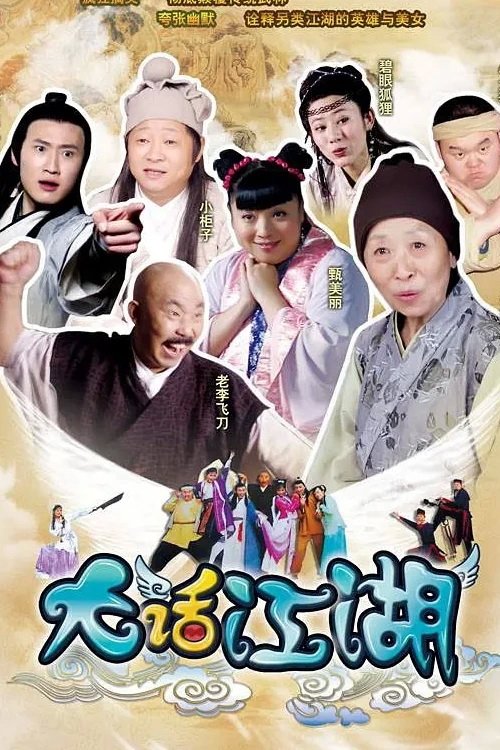
The jianghu, that storied landscape of drifting swordsmen, feuding schools, and outsized legends, has been a staple backdrop of Chinese screen fiction for decades. When Da Hua Jiang Hu (大话江湖) appeared in 2010, it chose to handle that well-worn territory with humor rather than gravity. What follows covers the essentials: who appears on screen, how the show is structured, what it feels like, and how audiences in the United States can find it.
A Wuxia World With a Wink
The name of the show telegraphs its sensibility. "Da hua" carries the sense of boasting or telling inflated stories, and joined with "jianghu," the traditional word for the realm of fighters and drifters, it announces a program that treats its own material with a raised eyebrow instead of a solemn bow. Expect laughs rather than brooding heroics.
That choice gives the series its own niche. Audiences raised on earnest costume epics may welcome the change of pace, while viewers fond of spoof-driven storytelling will see the lineage the show follows.
The Premise, Explained Without Spoilers
The series centers on a lively group of figures making their way through the martial-arts world, complete with the plots, partnerships, and crossed wires typical of that fictional universe. It treats the jianghu as a stage for character comedy, with adventure flavored by action and seasoned by situational humor.
Given its fondness for embellishment, the storytelling frequently upends what genre fans anticipate. Recognizable types, the roving hero, the conniving adversary, the towering master, all appear, yet the show handles them with playful affection instead of solemnity. Specific plot turns are left for viewers to discover on screen.
Season Structure and Episode Format
Records list the series with one season and a small number of episodes, a lean format typical of many Chinese shows from that period: a contained run rather than an open-ended commitment. Its debut came on June 15, 2010, and it is registered as a returning series, leaving the door open for the story to extend past its first outing.
That modest length works in the show's favor for newcomers, offering a low-commitment way to sample Chinese comedy-drama without signing up for a hundred-episode marathon. The standalone quality of the first run also lets viewers start watching without any preparation.
Main Cast and Characters
Leading the ensemble is Zhang Shaohua, a veteran performer widely admired by Chinese TV audiences, portraying Lü Hejin. Her involvement lends the production substantial acting credibility, and the parts she takes on are often the most unforgettable features of whatever she appears in.
Sharing the screen with her are He Jing as Zhen Meili, Wang Ke as Duan Yonghua, Zhao Liang as Xiao Guizi, Ma Changbao as Wanlifeng, and Jiang Yang as Guo Yingying. The names themselves hint at the show's mischievous spirit, ranging from the modest to the grandiose. As a true ensemble piece, the series spreads both its laughs and its dramatic beats across the whole group instead of leaning on one star.
Creators and Production
Publicly available details about the creative team are scarce, a common situation for Chinese series of that era, particularly ones released without much overseas publicity. What the finished show makes evident is a production combining period-style sets and wardrobe with a modern comic sensibility.
The series is unmistakably Chinese in origin, made in Mandarin, and it mirrors the domestic television currents of 2010, when playful riffs on traditional genres were winning over viewers. Pairing seasoned character players with a younger supporting group points to a strategy designed to appeal across age brackets.
Broadcast Status and Availability
The show first aired on June 15, 2010, and its listing gives that same date as the last air date of the initial run. Its "returning series" designation signals that the property has not been formally wrapped up and may resume or return in some form.
For American audiences, the series can be streamed, giving viewers outside China a chance to explore Chinese television beyond the most widely exported titles. Since availability differs across platforms and shifts over time, it is wise to verify current listings.
Themes, Tone, and Style
In tone, the program balances comedy against martial-arts drama. Its laughs spring from the interplay among characters and from good-natured ribbing of the genre's own conventions. Stylistically it embraces exaggeration and theatricality, in keeping with a title that promises tall tales.
On the thematic side, the series explores the loyalties and rivalries that shape life in the jianghu: friendship, ambition, mistaken identity, and the distance between the legends people recount and the untidier truth underneath. Entertainment comes first, though its fond parody doubles as a nimble commentary on how martial-arts tales get told.
Who Will Enjoy It
Anyone drawn to comic spins on period and martial-arts material should find much to appreciate, as should admirers of ensemble work in which no one performer towers over the rest. Fans of Zhang Shaohua have an especially clear incentive to look it up, given her reputation among Chinese television viewers.
The show also works as a gateway for those new to Chinese TV who prefer something brief and breezy over the epic-length sagas that dominate the field. Viewers hoping for a grave, high-stakes wuxia epic should recalibrate, however: this series would rather flash a grin than draw a sword in earnest.
Where to Watch
Viewers in the United States can locate Da Hua Jiang Hu on streaming services that host Chinese-language programming. Since catalogues change, confirming that it is currently offered before planning a session is worthwhile.
The series plays in its original Mandarin, so those who rely on subtitles should come prepared. Its short first season can be finished over a handful of sittings.
Frequently asked questions
What is Da Hua Jiang Hu (大话江湖) about?
It is a Chinese series set in the jianghu, the traditional realm of martial artists and wanderers, presented with a comedic, exaggerated flavor rather than as a sober epic. Plot specifics are best experienced by watching.
When did Da Hua Jiang Hu premiere?
It debuted on June 15, 2010, in China. Its initial run is listed as one season with a compact episode count.
Who stars in Da Hua Jiang Hu?
The principal cast features Zhang Shaohua as Lü Hejin, He Jing as Zhen Meili, Wang Ke as Duan Yonghua, Zhao Liang as Xiao Guizi, Ma Changbao as Wanlifeng, and Jiang Yang as Guo Yingying.
Is Da Hua Jiang Hu still running?
Its status is listed as "returning series," meaning it has never been formally concluded, although its first episodes aired back in 2010.
Where can I watch Da Hua Jiang Hu in the US?
US audiences can stream the series on platforms offering Chinese-language television. Offerings differ by service, so consult current listings before watching.



Comments (0)
Log in or create a free account to comment, rate and write reviews.