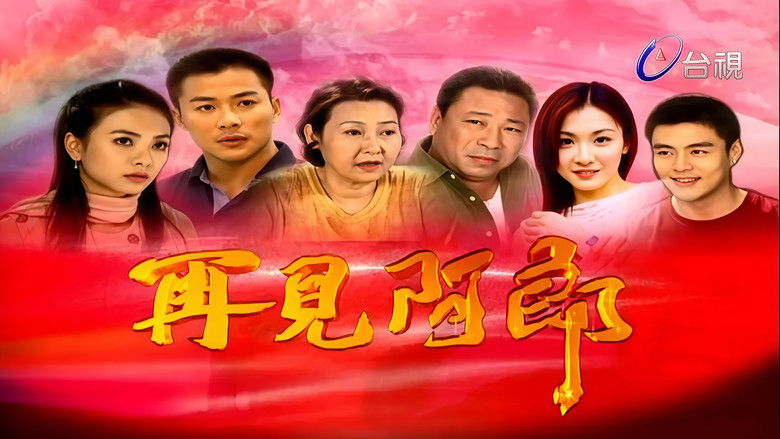

Taiwan's television history is rich with extended family sagas, and Goodbye Ah Lang (再見阿郎) remains a notable example from the early 2000s. Debuting in 2003, the series combines domestic, character-focused storytelling with themes spanning multiple generations. Whether you're discovering classic Taiwanese television for the first time or hunting for an emotionally driven serial, this overview gathers the essential details.
The Story Behind Goodbye Ah Lang
Goodbye Ah Lang is fundamentally a portrait of a household — how its members hold one another close and how old hurts can drive them apart. The narrative follows the Liu family as its various relatives experience affection, deception, distance, and, ultimately, attempts to mend broken bonds throughout the show's extended broadcast.
The figure at the heart of the title is shown at several points in his life, a device that lets the drama trace the consequences of one man's decisions as they spread through the people connected to him. Instead of a single dominant storyline, the script interlaces numerous strands among parents, offspring, and wider relatives, with each character carrying private struggles and hidden truths.
True to the Taiwanese family-drama tradition, the plot advances at a deliberate pace, giving relationships time to grow and rifts time to widen across many installments. Anyone expecting a compact, quickly resolved tale should understand from the outset that this is a patient, character-led production.
Format and Episode Count
The drama aired as one season totaling 159 episodes, each clocking in at roughly an hour. A count of that size marks it as classic long-form Taiwanese primetime fare, built to stretch across months of daily broadcasts.
The sixty-minute runtime lets every installment juggle several threads: a household dispute, a budding romance, and a softer moment of character reflection. Episodes generally close on hooks designed to pull audiences back the following day — a signature of the serialized daily format.
The length may look daunting to newcomers, yet it also means persistence pays off. Characters have room to evolve, bonds shift in believable steps, and emotional climaxes carry greater force than they would in a shorter run.
Performers and Their Roles
A broad ensemble brings the Liu household and the figures surrounding them to life. Nick Chiang stars as Liu Yuan-Lang while also embodying the younger Liu Ming-Lang, forming the backbone of the show's generational arc. Kao Ming handles a double assignment as Liu Jin-Hu and Liu Jin-Peng, and Chang Mei-Yao takes the part of the elderly Wang Mei-Chih, otherwise known as Liu Kuei-Hsiang.
Amigo Chiang appears in the twin roles of Chen Feng and Chen Ying, and Ray Fan takes on Kuo Ching-Hua. The Kuo side of the story is likewise split across generations: Liu Chang Ming plays the middle-aged Kuo Tien while Rex Kao Yun-han appears as his younger self, giving the series a generational counterpart to the Liu family.
Completing the main lineup, Chih-Han Liu plays Cheng Tsung-Sheng, Chan Chung-Yung is cast as Cheng Ku-Yi, and Cindy Mong portrays Hsu Li-Yuan. These doubled and age-spanning casting decisions echo the drama's fixation on time itself — how people transform, and how the past continues to exert its pull.
Behind the Scenes and Production Credits
Kuo Chien-Hung, an experienced name in Taiwanese TV drama, produced the series. It came out of Ying Hua Communication Company (映畫傳播事業股份有限公司), a studio linked to several of Taiwan's lengthy drama runs.
Mounting a 159-episode production is a serious logistical challenge. Serials of this kind in Taiwan are generally shot under tight timetables, frequently close to their air dates, requiring disciplined script teams and performers able to keep their characters alive across months of nonstop filming.
The show launched on November 11, 2003, with its full broadcast contained within that year, after which it was marked as ended. Its look reflects typical early-2000s Taiwanese drama standards: on-location filming, domestic sets, and an emphasis on acting rather than spectacle.
Tone, Themes, and Dramatic Style
Falling within the drama and family genres, the series carries a tone that is sincere, emotionally candid, and grounded in ordinary living. Anticipate dinner-table clashes, gentle reconciliations, misunderstandings that escalate, and the cross-generational tension that characterizes so much Taiwanese family fiction.
At the thematic level, the show probes legacy and selfhood. Casting separate actors as the youthful and aged versions of central figures drives home the point that family history is never fixed — it is handed down, replayed, and at times severed by each generation. Forgiveness, obligation, and the price of stubbornness recur throughout.
In terms of craft, the drama leans on dialogue and emotional showdowns rather than action or visual flourish. Audiences used to brisk Western programming may notice the unhurried tempo, but that measured rhythm is exactly what makes the relationships feel authentic.
Airing Status and Where to Watch
Goodbye Ah Lang is a finished series. It first aired in Taiwan in November 2003 and has long since wrapped, meaning audiences can experience the complete arc without waiting for further episodes.
Viewers in the United States can find the series on streaming services that carry Taiwanese drama programming. As the show is performed in Chinese, subtitle availability varies by platform, so it's wise to confirm that before settling in.
Given its age, the title may not always be prominently featured on major services, but being a completed single-season work makes it simple to approach on your own schedule — one episode per evening or a multi-episode marathon.
Is This Series Right for You?
Goodbye Ah Lang will resonate most with viewers drawn to multi-generational family stories who are comfortable with a lengthy viewing commitment. Admirers of Taiwanese and Chinese-language serials, especially those fond of slow-building domestic narratives, will find plenty to appreciate.
The show also suits anyone curious about the cultural landscape of early-2000s Taiwan — the household dynamics, social pressures, and everyday environments that anchor the story in its era. Those favoring fast plots, genre excitement, or compact limited runs may find the 159-episode scale demanding.
For audiences ready to make the investment, the payoff is a deeply textured depiction of a family across time, supported by performances given ample room to develop over the show's long life.
Frequently asked questions
What is the plot of Goodbye Ah Lang (再見阿郎)?
It is a Taiwanese family drama built around the Liu family, tracking its members through successive generations as they face romance, estrangement, buried secrets, and eventual reconciliation. The narrative moves at a gradual pace across a lengthy serialized run, in keeping with the Taiwanese drama tradition.
How long is Goodbye Ah Lang?
The show spans 159 episodes across a single season, with each episode lasting about 60 minutes. It began airing in Taiwan in November 2003 and has concluded, so the whole story can be watched from beginning to end.
Who appears in the cast of Goodbye Ah Lang?
Featured performers include Nick Chiang as Liu Yuan-Lang and the young Liu Ming-Lang, Kao Ming as Liu Jin-Hu and Liu Jin-Peng, Chang Mei-Yao as the elderly Wang Mei-Chih (Liu Kuei-Hsiang), plus Amigo Chiang, Ray Fan, Chih-Han Liu, Chan Chung-Yung, and Cindy Mong, among others.
When did Goodbye Ah Lang premiere, and is it still on air?
The series debuted on November 11, 2003, and finished its run within that same year. It is listed as ended, so the entire story is available without any waiting for new installments.
Can I watch Goodbye Ah Lang in the United States?
Yes — the series is accessible to US audiences via streaming platforms that feature Taiwanese drama content. Because it is a Chinese-language production, review each platform's subtitle options before you begin to ensure a smooth viewing experience.























Comments (0)
Log in or create a free account to comment, rate and write reviews.