
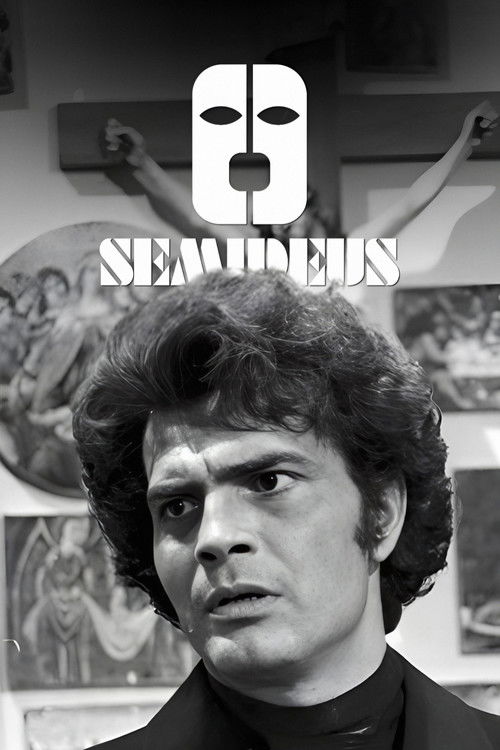
Janete Clair occupies a towering place in the story of Brazilian broadcasting, and O Semideus ranks among the boldest projects she ever penned. TV Globo carried the serial from 1973 into 1974, uniting a roster of the nation's finest actors for a tale about image, influence, and remaking oneself. Anyone drawn to the heyday of the telenovela will find it a revealing artifact of that pivotal period.
The Story Behind O Semideus: Plot Basics Without Major Reveals
At the heart of the series is Hugo Leonardo Filho, a figure who has risen to extraordinary prominence and appears nearly invincible within Brazilian society. The name of the show — meaning 'The Demigod' — points directly to its core question: what does it mean when the world elevates a man beyond human scale, and what hides underneath that legend?
Avoiding the plot turns that captivated audiences at the time, the narrative tracks Hugo as his polished existence begins to collide with lives far removed from his own. A double-identity thread powers much of the drama, giving the writers room to probe class divisions, self-reinvention, and the burden of a polished public persona.
True to Janete Clair's style, the appeal lies less in one central riddle than in the tangle of bonds surrounding the lead. Love, family ties, and the hunger for status intertwine as the story develops over its long broadcast run.
Episode Count and How the Season Was Organized
The serial unfolded as one uninterrupted season totaling 221 episodes, in keeping with the standard telenovela model of 1970s Brazil. Instead of the short, closed seasons today's viewers know, installments ran on weeknights and braided together several plotlines, with each broadcast closing in a manner meant to pull viewers back the following night.
Its first episode aired on August 22, 1973, and the finale arrived on May 7, 1974 — a span of close to eight and a half months. This rhythm mirrored TV Globo's scheduling philosophy of the day, when serials were nightly rituals and their conclusions counted as genuine national occasions.
Sustaining interlocking storylines rather than isolated episodes required exceptional discipline from the writers. Clair built her reputation on juggling enormous casts and scores of threads simultaneously, and this series showcases that mastery clearly.
Principal Performers and the Roles They Played
The ensemble reads, decades later, like a roll call of Brazil's acting elite. Tarcísio Meira anchors the production as Hugo Leonardo Filho, additionally portraying Raul de Paula — a double role tied directly to the show's identity-driven premise. Across from him stands Glória Menezes as Ângela Santana, prolonging one of the most admired screen duos in the country's television history.
The orbit around this pair brims with accomplished names. Francisco Cuoco takes the part of Alexandre 'Alex' Garcia Maia, while Yoná Magalhães embodies Adriana Penha. Juca de Oliveira, widely admired in his era, plays Alberto Parreiras. Nívea Maria appears as Soninha, whose full name is Sônia Vilaça, and Maria Cláudia fills the role of Estela.
Completing the main lineup are Felipe Carone as Gildo Graça Penha, Zbigniew Ziembinski as Padre Pavel Miodek, and Miriam Pires as Dulce Leonardo. All were mainstays of Brazilian theater and screen, and their involvement lent the serial a dramatic weight uncommon in ordinary serialized fare.
Who Made the Show: Writing and Direction
Janete Clair both conceived and scripted O Semideus, her name having become nearly interchangeable with the contemporary Brazilian telenovela. She had a gift for anchoring serialized drama in present-day social conditions, fusing melodrama with keenly drawn characters and timely subject matter. Her screenplays shaped the blueprint Globo would polish in the decades ahead.
Directing duties were divided among Walter Avancini, Jardel Mello, and David Grimberg. Avancini would later rank among the most consequential directors in the country's television landscape, and his contribution here coincided with Globo's steep climb in production quality.
Estúdios Globo, the network's own production house, handled the making of the series during a stretch when Brazilian serials were growing ever more cinematic. The pairing of Clair's exacting scripts with a capable trio of directors produced a program that raised the standard for everything that came after.
Broadcast Details: Network, Dates, and Current Status
The serial was carried by TV Globo, the leading broadcaster in Brazil and the engine room of Latin American telenovela making. Its airing period, August 1973 through May 1974, fell within a fiercely contested stretch for Brazilian television, as the network cemented its standing for high-caliber drama.
Its status is listed as Ended, and the 221 episodes form a finished, self-contained narrative. More than most serials of its day, it continues to surface in retrospective conversations about the country's television heritage, owing largely to the renown of its author and performers.
For those abroad, it is a Portuguese-language work originating in Brazil, and its age positions it as a genre classic rather than anything resembling current programming.
Subject Matter, Mood, and Visual Approach
Identity-building sits at the core of the series — the distance between a man's outward image and his true self. The mythological ring of the title is knowingly ironic: the program dissects a person society treats as half-divine and weighs what that adulation costs him and everyone near him.
Class stratification and the climb up the social ladder matter just as much. Contrasts between separate social spheres were a hallmark of Clair's scripts, and in this case they drive both the romantic and dramatic currents. Ambition, faithfulness, and how easily a reputation can crumble echo across the story.
Mood-wise, this is earnest drama rather than breezy romance, though it keeps the emotional charge and braided plots typical of the soap genre. In style, it reflects its period's blend of live and taped production, with attention fixed firmly on acting and dialogue instead of visual grandeur.
Which Viewers Will Appreciate It
Those fascinated by television's past will get the most from the series. It represents a cornerstone of Clair's output, and watching her hallmark methods — socially conscious plotting, morally shaded leads, and ensemble-driven narrative — at work in one of her early successes illuminates how today's telenovela came to be.
Admirers of vintage Brazilian performers have reason to tune in as well. Meira and Menezes ranked among the defining screen duos of their generation, and the supporting lineup amounts to a portrait gallery of the period's best talent.
Lastly, anyone drawn to extended melodrama with real depth — tales of identity, social standing, and image rather than plain hero-versus-villain setups — will find much to admire, so long as they can accept the rhythm and habits of 1970s serialized television.
Viewing Options
Given its early-1970s Brazilian origins, the series is a vintage title, and access differs from place to place. Those in the United States can consult current streaming services and digital outlets focused on classic international television to determine whether it is offered locally.
Since the program is in Portuguese, viewers elsewhere may wish to seek out subtitled versions when they exist. Thanks to its cultural weight and the lasting fame of its creator and cast, it occasionally reappears in retrospectives and curated anthologies of classic telenovelas, so fans of old international drama should watch platform schedules closely.
Frequently asked questions
What were the original air dates of O Semideus?
It debuted on TV Globo on August 22, 1973, and broadcast its last episode on May 7, 1974, covering close to eight and a half months of weeknight transmissions.
What is the episode total for O Semideus?
The telenovela spans 221 episodes within a single season. That uninterrupted structure was the norm for Brazilian serials of the era, and the narrative wrapped up with the series' conclusion.
Who was responsible for creating and writing the series?
Janete Clair alone created and wrote the program, standing among the most consequential talents in Brazilian television. Walter Avancini, Jardel Mello, and David Grimberg shared the directing work.
Which actors headline O Semideus?
Tarcísio Meira fronts the cast as Hugo Leonardo Filho and Raul de Paula, joined by Glória Menezes as Ângela Santana. Francisco Cuoco, Yoná Magalhães, Juca de Oliveira, and Nívea Maria hold major supporting parts.
What is the premise of O Semideus?
The Brazilian drama follows Hugo Leonardo Filho, whose immense public standing comes under strain once a concealed dimension of his life surfaces. Its themes include identity, social class, and the price of a larger-than-life image.























Comments (0)
Log in or create a free account to comment, rate and write reviews.