
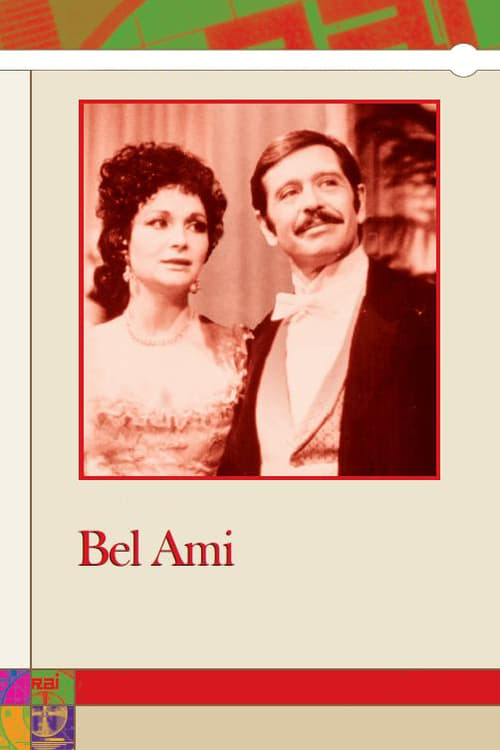
Italian broadcasters were adapting canonical literature for prime-time audiences long before literary adaptation became a prestige television staple. Bel Ami, a drama in four parts shown on Rai 2 during the final weeks of 1979, transferred Guy de Maupassant's famous tale of seduction and ambition to the screen, fronted by Corrado Pani alongside an ensemble of veteran Italian and international performers.
What Is Bel Ami About?
The miniseries draws on Guy de Maupassant's novel Bel Ami, among the most lasting portraits of social climbing in French fiction. At its center stands Georges Duroy, an attractive and determined young man who reaches Paris nearly penniless and without useful contacts. Though he has no family name to rely on, his personal charm proves a powerful currency, and he soon discovers that magnetism can open doors that talent or lineage cannot.
Duroy works his way into journalism and fashionable society by befriending powerful men and, more importantly, the women around them. The narrative charts how his deliberately cultivated romances unlock opportunities that would otherwise stay shut, and how every achievement only sharpens his appetite for the next one. At heart, this is a drama about hunger—for status, wealth, and public admiration.
The adaptation stays true to the novel's spirit, so viewers who know Maupassant will recognize the story's structure, yet no familiarity with the book is required to follow along. Emphasis falls on character and consequence rather than spectacle.
Season Structure and Episode Format
Rather than an open-ended drama, Bel Ami was designed as a self-contained miniseries. It comprises one season of four episodes, giving the narrative a tight, novel-like arc. Each installment covers a separate phase of Duroy's professional and private rise, so the parts read as acts of one continuous story rather than isolated chapters.
Rai 2 broadcast the series between November and December 1979, with the concluding episode airing on December 14 that year. Its status is recorded as ended, confirming that the story wrapped within the original run and no additional seasons were produced.
That compact length is a draw for today's audiences. Four episodes offer an easy entry point into classic literary television without the demands of a long serial, and the unhurried pacing mirrors the measured rhythm of the source novel.
The Cast and Their Characters
Corrado Pani takes the lead as Georges Duroy, the seductive antihero driving the plot. A seasoned Italian screen performer, Pani faced the challenge of keeping Duroy likable even as the character's self-serving nature grows ever more obvious—the role calls for a blend of charm and cold calculation.
Surrounding him is a supporting group drawn from Maupassant's portrait gallery of Parisian high society. Martine Brochard appears as Clotilde de Marelle, a woman whose affection plays a decisive part in Duroy's advancement. Rada Rassimov plays Madeleine Forestier, whose sharp mind and connections help steer the course of his ambitions.
Two pillars of Italian theatre and cinema bring the powerful Walter household to life: Arnoldo Foà as Mr. Walter and Caterina Boratto as Mrs. Walter. Marco Bonetti completes the principal lineup as Jacques Rival, adding a further thread to the social and professional network Duroy navigates.
Creators and Production
Sandro Bolchi, a director noted for his work in literary television, helmed the miniseries. Bolchi also teamed with Letizia Palma on the screenplay, reshaping Maupassant's prose for the serialized format. Their partnership reflects RAI's production culture of the era, when the public broadcaster routinely mounted ambitious screen versions of classic literature.
RAI, Italy's national broadcasting company, produced the series in-house. That institutional support mattered: the broadcaster's literary dramas generally featured theatre-caliber casts and a close adherence to the source text that commercial television seldom matched. Bel Ami stands within that tradition of adaptations created to bring serious fiction to a wide audience.
Maupassant's novel suited the format well. Its episodic tracking of Duroy's career lends itself naturally to serialization, and the book's keen eye for social behavior translates effectively to the intimate scale of the small screen.
Network, Broadcast and Availability
The series debuted on Rai 2, a channel of Italy's public broadcaster, on November 23, 1979. The four episodes ran over the ensuing weeks, finishing on December 14, 1979. Made in Italian, its original language, the series is now counted among RAI's classic literary miniseries.
In the United States, the show is listed as available to view, though given its age—nearly half a century old—platform availability may differ by service and catalog. Anyone hoping to find it should consult current streaming listings, as older imported dramas often shift between platforms.
As a completed single-season work, there is no broadcast schedule to track; the entire story is contained within the original four episodes.
Themes, Tone and Style
Bel Ami fundamentally examines ambition and the transactional character of social life. Maupassant's novel is famously unsparing about how power moves through Parisian society, and the adaptation keeps that critical sharpness. Romance here is never simply romance: each relationship carries weight for status, money and influence, and the drama builds its tension from that intersection.
The series is tagged as both a romance and a drama based on a book, and both descriptions hold. The relationships Duroy forms carry real emotional weight, yet the tone stays measured and observational rather than melodramatic, in line with its literary origins.
Stylistically, the show embodies 1970s European television drama: deliberate pacing, theatrical acting, and an emphasis on dialogue and character over action. Audiences used to modern rhythms may find it slow, but that tempo forms part of its period appeal and matches the novel's satirical perspective.
Who Will Enjoy Bel Ami?
The miniseries will resonate most with viewers drawn to classic literary adaptations and period drama with a biting social edge. Devotees of Maupassant's novel will find a faithful, skillfully cast rendering, while enthusiasts of 1970s European television will value the production standards and performances RAI delivered.
It also suits anyone drawn to tales of social ascent and morally complicated leads. Duroy is far from a traditional hero, and much of the show's appeal lies in observing just how far charm can take a man prepared to exploit it.
On the other hand, those seeking brisk pacing, modern production techniques, or action-heavy storytelling may find it a slow experience. Like the novel it adapts, the series rewards patience and an interest in character.
Frequently asked questions
Is Bel Ami based on a book?
Yes. The miniseries adapts the novel Bel Ami by the French writer Guy de Maupassant, with the teleplay credited to Letizia Palma and director Sandro Bolchi. It tracks the novel's hero, Georges Duroy, as he ascends Parisian society.
How many episodes does Bel Ami have?
It is a single-season miniseries of four episodes. Rai 2 aired all of them between November and December 1979, and the story reaches its conclusion within that one run.
Who plays Georges Duroy in Bel Ami?
Corrado Pani portrays Georges Duroy, the charismatic and ambitious lead. Around him, the cast features Martine Brochard as Clotilde de Marelle, Rada Rassimov as Madeleine Forestier, and Arnoldo Foà and Caterina Boratto as Mr. and Mrs. Walter.
Who directed the Bel Ami miniseries?
Sandro Bolchi directed the series and co-adapted it with Letizia Palma. RAI, Italy's national public broadcaster, produced it, and it first aired on Rai 2 in 1979.
Where can I watch Bel Ami in the US?
The series is listed as available in the United States, but as a classic 1979 production its streaming placement may shift. Check current catalogs and listings to see where it can be found.












Comments (0)
Log in or create a free account to comment, rate and write reviews.