
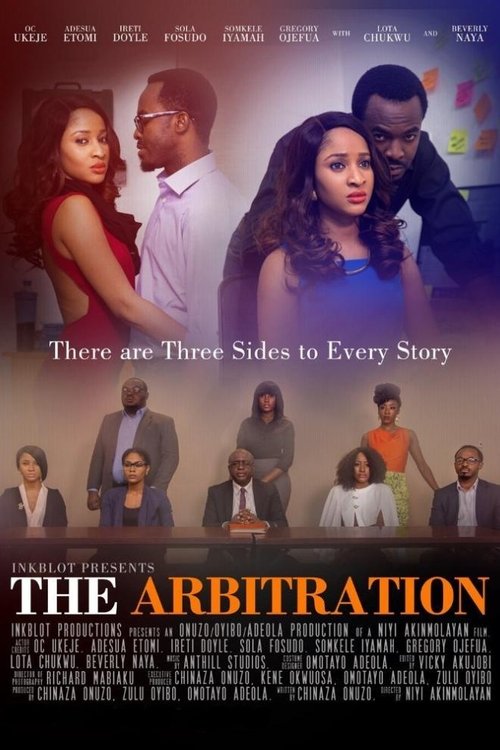


When it premiered, The Arbitration became one of the most talked-about releases in recent Nollywood history. This 2016 legal drama, helmed by director Niyi Akinmolayan and scripted by Chinaza Onuzo, puts issues of workplace authority, consent, and the very nature of truth under scrutiny. Much of the story plays out inside a formal hearing, transforming a painful private conflict into a tense, absorbing procedural that has since become a benchmark for modern Nigerian filmmaking.
A Courtroom Drama That Asks Hard Questions
Released in Nigerian cinemas in August 2016, the film immediately distinguished itself from much of mainstream Nollywood by avoiding melodrama and supernatural elements. Instead, it settles into a restrained setting: a hearing room in which two individuals offer accounts of one relationship that cannot both be true.
That discipline is the source of its power. Denied spectacle, the film leans entirely on acting, dialogue, and the gradual build-up of uncertainty. Audiences effectively sit alongside the arbitrators, judging testimony, motive, and credibility as each party makes its case.
The outcome is less a piece of entertainment than a prompt for argument. In the years since release, the film has kept sparking online discussion about its central conflict, evidence of how powerfully it dramatises questions that offer no comfortable resolution.
The Premise, Explained Without Spoilers
At the heart of the story is Gbenga, a prosperous chief executive portrayed by OC Ukeje, whose career and private life become entangled when a woman who once worked for him files suit. She claims wrongful dismissal and accuses him of rape. The complication is that the pair previously shared a consensual relationship, a fact that muddies the boundary between an employment dispute and a far graver allegation.
Rather than proceeding to open court, the dispute is placed before an arbitration panel, a private tribunal charged with untangling the rival narratives. This framework lets the film alternate between formal proceedings and flashbacks to the affair, showing how sharply the two parties' memories of identical moments diverge.
Beyond that, the plot is best left unspoiled. What is safe to say is that the film is less concerned with handing down a neat judgment than with exploring how hard certainty is to reach when authority, intimacy, and recollection collide.
Standout Performances from a Strong Cast
Everything hinges on the two leads. OC Ukeje, widely considered among Nollywood's most reliable performers, gives Gbenga real depth: a figure assured in the boardroom yet progressively unsteady under examination. He avoids caricature, playing Gbenga as neither a straightforward villain nor a clear-cut victim.
Across from him, Adesua Etomi-Wellington turns in work that helped establish her as one of the most striking actresses of her generation. Within a single scene she can project both resilience and fragility, leaving viewers uncertain about where her character's truth actually sits.
The ensemble around them supplies rich support. Ireti Doyle, seasoned across stage and screen, lends weight to her part, and Lota Chukwu completes a group whose every exchange feels authentic and charged. It is a cast confident in the material, and that confidence is contagious.
Niyi Akinmolayan Behind the Camera
By the time he took on this project, Niyi Akinmolayan had long been a fixture of Nigerian cinema, admired for pairing commercial savvy with a refined visual sensibility. Here he revealed another side of his craft: controlled, dialogue-led filmmaking where suspense is generated by expressions and language rather than spectacle.
Chinaza Onuzo's screenplay is just as vital to the film's effect. Its architecture, shuttling between the hearing and the events preceding it, keeps the audience actively assembling a timeline that is intentionally disputed. The dialogue is crisp without straining for effect, and the script handles its difficult subject with a care rare in a mainstream release.
Director and writer together helped mark Nollywood's movement toward grounded, present-day stories capable of standing beside international drama. The brisk 100-minute runtime speaks to that assurance; no scene lingers too long.
Themes, Tone and Style
Fundamentally, the film asks how truth can be established when two believable versions of events clash. It probes hierarchies at work, the way romance entangles professional life, and the inadequacy of formal legal mechanisms for settling profoundly human disputes.
In tone it is measured and mature, closer to a chamber piece than a standard Nollywood production. The hearing room supplies a cool procedural shell, while flashback passages carry warmth and closeness, and the tension between those two registers is built into the film's design.
Aesthetically it is sleek and modern, capturing contemporary corporate Lagos with a sharpness that was striking for Nigerian film at the time. The style never announces itself; it simply serves the narrative, keeping attention fixed on the acting and the moral burden of the evidence.
Who Will Enjoy This Film
Anyone drawn to dialogue-heavy legal and courtroom stories will find much to appreciate, as will viewers following Nollywood's newer wave of refined, city-set storytelling. The film demands attention, casting the audience as judge and jury beside the panel.
It also suits people who like movies that provoke conversation. Since its central conflict defies easy interpretation, The Arbitration reliably stirs debate well after the final scene, which makes it an excellent pick for a group screening or film club.
Those after action, conventional romance, or light comedy should choose something else. This is a serious, adult drama that requires its viewers to tolerate unease and unanswered questions.
Where to Watch
Audiences in the United States can stream The Arbitration on Tubi, where it is available at no cost with ad support. That makes it a convenient way to sample contemporary Nigerian cinema without buying a copy or taking on a subscription.
Streaming rights differ by region and shift over time, so it is sensible to confirm the current listing on your platform of choice. As Nollywood reaches broader international viewership, titles like this one are becoming increasingly common on major ad-supported services.
Similar Titles Worth Exploring
If the film leaves you hungry for more, the rest of Niyi Akinmolayan's directing catalogue is an obvious starting point, ranging from family adventures to large-scale Nigerian productions that display his versatility beyond understated drama.
Admirers of Adesua Etomi-Wellington can find her in many notable Nollywood roles from the same period, and OC Ukeje's body of work holds further examples of his subtle lead performances. Chinaza Onuzo's scripts for other recent Nigerian films share this one's incisive, character-first sensibility.
For those drawn to legal and moral-dilemma stories in general, the film sits comfortably alongside international courtroom dramas built on disputed testimony. Within Nollywood itself, the mid-2010s yielded a cluster of polished urban dramas, and The Arbitration endures as a defining entry in that movement.
Frequently asked questions
What is The Arbitration about?
The 2016 Nigerian drama follows a company CEO who is sued by a former employee and one-time lover for wrongful dismissal and rape. The case goes before an arbitration panel, which must weigh the two sides' conflicting accounts of their relationship.
Who directed The Arbitration?
The film was directed by Niyi Akinmolayan, a prominent Nigerian filmmaker, from a screenplay by Chinaza Onuzo. It was released in 2016 and runs approximately 100 minutes.
Who stars in The Arbitration?
The cast is led by OC Ukeje as Gbenga, the CEO at the centre of the dispute, alongside Adesua Etomi-Wellington, Ireti Doyle, and Lota Chukwu in key supporting roles.
Where can I watch The Arbitration in the US?
In the United States, The Arbitration streams on Tubi, where it is available to watch for free with advertisements. Availability may change, so check the platform for current listings.
Is The Arbitration worth watching?
For fans of dialogue-driven legal dramas and modern Nollywood, it is widely regarded as a standout. Its contested-narrative structure and strong central performances make it a film that continues to provoke debate among viewers.









Comments (0)
Log in or create a free account to comment, rate and write reviews.