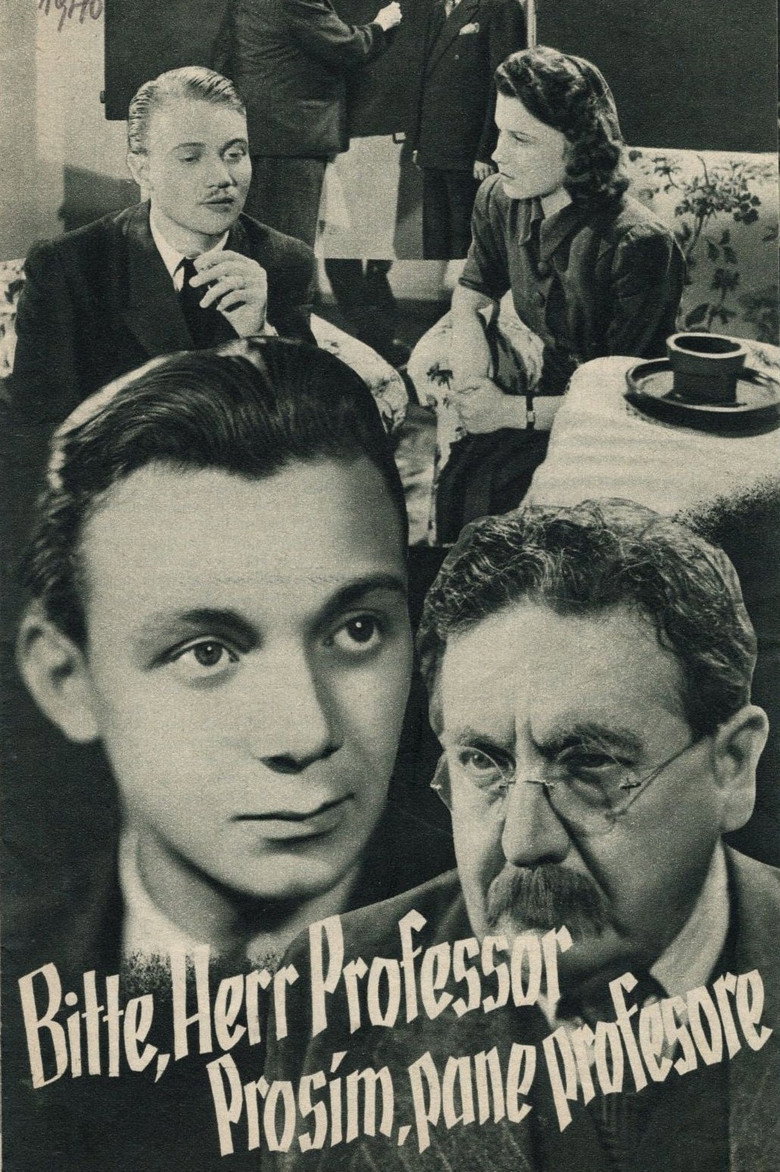
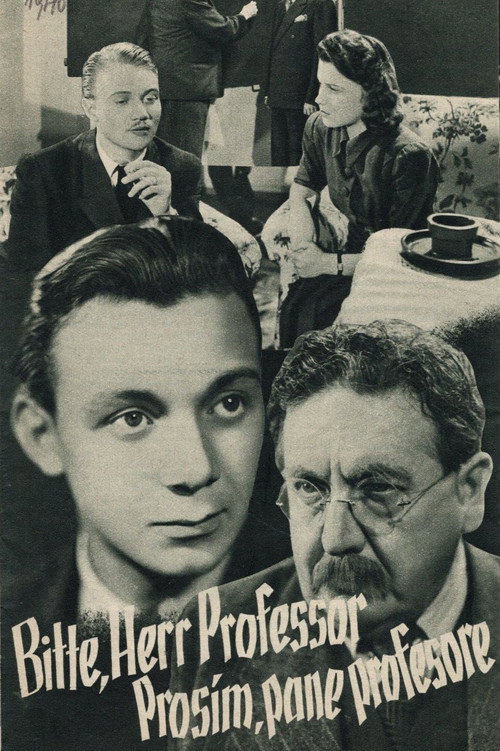
During the early years of the 1940s, Czech filmmakers turned out a steady supply of unassuming, human-scale pictures, and Prosím, pane profesore! is a fine example of that output. The film reached cinemas on 13 September 1940. Combining dramatic and family elements, it brings Jiří Karásek's novel to the screen with an ensemble of seasoned performers, telling a story rooted in school life and the grown-ups who shape it.
A School Story With Heart
Some films find their material in the everyday, and this one does so with quiet confidence. Its Czech title, roughly rendered in English as 'Please, Professor!', points to the relationship at its heart: the connection between a teacher and the pupils who populate his world.
Instead of spectacle, the picture draws on familiar textures — lessons, household exchanges, and the gentle friction between generations. Contemporary viewers could easily see themselves on screen, and that sense of recognition is still what gives the film its appeal.
The storytelling stays deliberately modest. There are no dramatic flourishes or forced surprises; the interest comes from how people behave toward one another and from the small decisions that fill a school year and a family life.
The Premise, Spoiler-Free
The screenplay, adapted from Karásek's novel, follows a group of pupils whose paths cross with their professor and with the households around them. The student circle includes Jaroslav Šmolka, portrayed by Jiří Vondrovič, and Jaromír Tureček, played by R. A. Strejka. Jarmila Beránková appears as Věra Skalská, adding another strand to the group's connected lives.
The older generation carries equal weight in the story. Karel Černý takes the part of Ing. Šmolka, while Jára Kohout plays Emanuel Skalský, linking the pupils' school days to their home surroundings. Rudolf Hrušínský features as Antonín Vobořil, František Roland appears as Šaman, and Raoul Schránil rounds out the cast as Karel.
Holding everything together is Theodor Pištěk in the role of Hladík, a performance that anchors the entire picture. Details of how these relationships unfold are best left undiscovered; it is enough to know that the narrative shuttles between schoolroom and dinner table, resolving through the characters' ordinary entanglements.
Standout Cast and Performances
The ensemble is the picture's strongest suit. Pištěk, a seasoned presence on Czech stages and screens known for his warmth and comic touch, gives the film its center of gravity through his portrayal of Hladík. Around him, Jiří Vondrovič and R. A. Strejka lead the youthful contingent, bringing school-day vitality to the screen.
Hrušínský stands out even in his supporting turn as Vobořil. He would later earn a place among the most admired character actors of Czech cinema, and early work like this hints at the reason. František Roland, Jára Kohout, and Hermína Vojtová complete a lineup of faces familiar to audiences of the day.
The acting is most rewarding in the exchanges between generations. The younger players handle mischief and sincerity convincingly, while their elders lend each scene the patience and tenderness of adulthood. This is a true ensemble piece rather than a showcase for one star, and the film is stronger for it.
Behind the Camera: Director and Production
Zdeněk Gina Hašler directed, working from a script by J. V. Vichovský and Jiří Karásek — Karásek adapting his own fiction. That author's involvement lends the film a bookish steadiness, letting events unfold with a patience closer to literature than to spectacle.
The picture was produced by the company Zdar, with Jaroslav Tuzar behind the camera as director of photography. His cinematography handles both interiors and outdoor scenes in the clean, understated manner typical of the era. Marie Bourová edited, giving the many small episodes of school and home life an unhurried rhythm.
Josef Dobeš supplied the original score, music that bolsters the film's domestic warmth without crowding it. The result is a production that feels carefully assembled rather than rushed — a craftsmanship that has held up over the decades.
Themes, Tone and Style
The film's subject is the journey from childhood toward responsibility, and the teachers and parents who ease or complicate that journey. Its dual classification as drama and family fits well: home scenes matter as much as school scenes, and the two settings continually mirror one another.
In tone it chooses warmth over melodrama. The comedy grows out of character rather than contrivance, and its dramatic beats are earned through many small conflicts. Formally, it exemplifies studio-era Czech filmmaking: efficient staging, lucid storytelling, and room for performances to breathe.
Its literary origins show in the structure, with episodes accumulating into a fuller picture of a community. Those expecting contemporary pacing should temper their expectations; the reward here lies in watching, not in speed.
Who Will Enjoy It
The film will appeal to admirers of classic European cinema and of Czech production from the early 1940s in particular. Devotees of Pištěk and Hrušínský get the chance to see both performers at this stage of their careers, and anyone curious about how period novels became films will find the adaptation revealing.
It also works as old-fashioned family viewing: the subject matter — school and home life — is universally accessible, and the mood is gentle. Those after breakneck plots or spectacle should recalibrate; this is a subdued, character-first picture.
Where to Watch
For audiences in the United States, access to Prosím, pane profesore! depends on current streaming and catalog offerings, which shift over time. As a 1940 title from the Czech producer Zdar, it may surface on platforms focused on classic or international film, or on disc via specialty labels.
The surest method is to search major streaming services and classic-cinema catalogs using both the original Czech title and its English translation. Regional differences apply, so viewers elsewhere should check their own local listings.
Similar Titles Worth Exploring
Those who respond to the film's mix of school and family material could seek out other Czech pictures from the same period, which often featured the same pool of character actors and a comparable observational warmth. The era yielded a continuous flow of comedies and dramas grounded in recognizable daily settings.
Anyone curious about Pištěk's wider output will find him active throughout Czech cinema of the 1930s and 1940s, while Hrušínský's later filmography traces the growth of one of the nation's finest character performers. Karásek's source novel is the obvious companion read for those wanting the full literary background behind the script.
Frequently asked questions
What is Prosím, pane profesore! about?
It is a Czech drama from 1940, based on Jiří Karásek's novel, revolving around a set of students, their families, and the professor who anchors their school world. It treats classroom and household matters with equal care in a warm, character-led manner.
When was Prosím, pane profesore! released?
It premiered on 13 September 1940. Zdeněk Gina Hašler directed the film, which was made by the Czech company Zdar from a screenplay by J. V. Vichovský and Jiří Karásek.
Who stars in the film?
Theodor Pištěk heads the cast as Hladík, supported by Jiří Vondrovič, R. A. Strejka, Rudolf Hrušínský, František Roland, Karel Černý, Jarmila Beránková, Jára Kohout, Hermína Vojtová, and Raoul Schránil.
Is Prosím, pane profesore! based on a book?
Yes. The script, credited to J. V. Vichovský and Jiří Karásek, was adapted from a novel by Karásek, who also co-authored the screenplay — a close link between page and screen.
Where can I watch Prosím, pane profesore! in the US?
US availability shifts over time, so look for the title on major streaming services and classic or international film catalogs under both the Czech and translated English names. Confirm on the platform you use, since listings change.













Comments (0)
Log in or create a free account to comment, rate and write reviews.