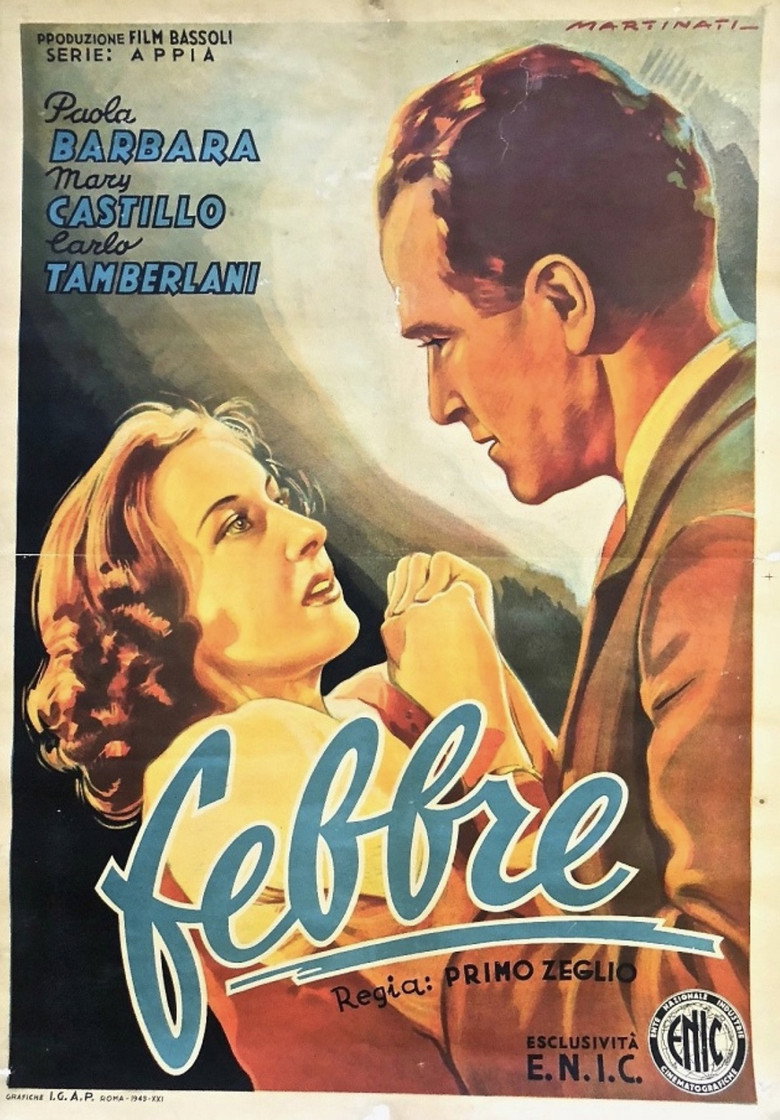
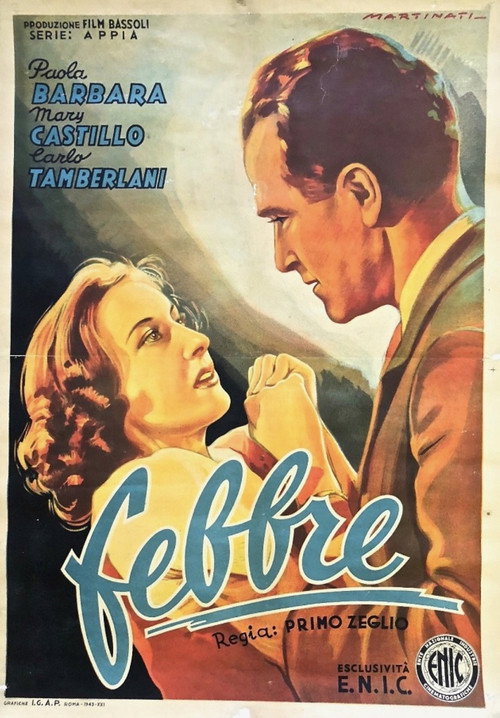
Not every film endures through commercial success; some persist because of the tale they weave and the historical moment they preserve. Fever, known in Italy under its original title Febbre, belongs to that category: a 1943 collaboration between Italian and Spanish filmmakers that combines melodrama, treachery and vengeance within a tight character portrait. With Primo Zeglio at the helm and a script from Corrado Alvaro, the picture stands as a revealing artifact of European moviemaking during one of history's most turbulent stretches.
What Is Fever (Febbre) About?
The story follows a man who returns home anticipating the life he left behind, only to find it transformed. Saverio Grantèr, portrayed by Carlo Tamberlani, comes back to Spain after an extended stay overseas, where he had been involved in treating a grave illness in Africa. Yet no hardship abroad could ready him for what awaits: his dearest friend has seized control of his enterprise and, more painfully, has won the heart of the woman to whom Saverio was betrothed.
This betrayal ignites something in him. Fixated on settling accounts with the friend who ruined him, Saverio wrestles with the pull between fury and self-control. The film is less a conventional revenge thriller than an examination of what unfolds when a second voice reshapes the logic of retribution.
That voice comes from a woman who was herself wooed and then deserted by the very same man. She urges Saverio to stand down, arguing that the right to punish the betrayer belongs to her alone. From this springs a compelling dynamic between two damaged souls weighing how far each is prepared to go.
The Cast: Faces of Wartime European Cinema
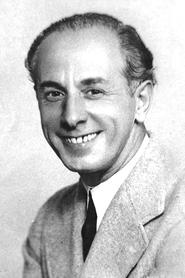
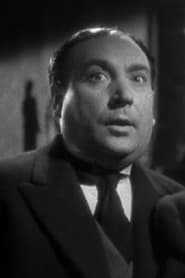
Carlo Tamberlani carries the picture as Saverio, a part requiring a man suspended between dignity and rage. A well-known figure in Italian film of that period, Tamberlani brings credible weight to the character's internal struggle.
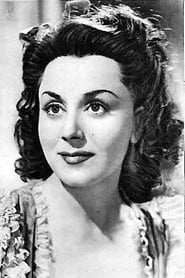
Across from him, Paola Barbara takes the part of Marga, one of the production's key female characters. Among the busiest Italian actresses of her day, Barbara supplies the drama with much of its emotional heft. Spanish performer Mary Carrillo, widely respected, appears as Gianna, and María Martín fills the role of Lola, underscoring the film's cross-national casting.
Felice Romano plays Pablo, while Jesús Tordesillas portrays the lawyer, a figure who in stories like this often embodies practical reasoning. Rounding out the ensemble are Joaquín Bergía, Ana María Quijada, Juan Calvo and Arturo Cámara, a lineup that mirrors the production's truly two-nation makeup.
Behind the Camera: Zeglio, Alvaro and a Split Production
Primo Zeglio helmed Fever during a stretch when the Italian film industry worked under severe wartime strain. Zeglio later enjoyed a lengthy directing career, and here he operates within the melodramatic mode that defined much of Europe's mainstream output in the early 1940s.
The script originates with Corrado Alvaro, a man whose reputation rested more on literature than on cinema. An accomplished Italian novelist and journalist, Alvaro lends the material a literary foundation: the narrative concerns itself less with plot machinery than with pride, treachery and the morality of getting even.
Film Bassoli and Ufisa, one Italian and one Spanish firm, produced the picture, which accounts for the blended cast and the Spanish backdrop. Two cinematographers, Enzo Riccioni and Mariano Ruiz Capillas, one drawn from each national side, shared the photography, and the editing duties were divided between Juan Francisco García and Angelo L. Comitti. What emerges is a work that authentically bridges two national film industries at a moment when such partnership was at once pragmatic and politically delicate.
Themes, Tone and Style
Fever sits squarely within the revenge melodrama tradition, yet its real fascination is how it unsettles that impulse. Saverio's urge to make his disloyal friend suffer is contested not by abstract notions of law or conscience but by a woman whose wound cuts even deeper than his own. Vengeance becomes a bargaining process between two individuals, each staking a claim to the moral authority to strike.
Even the title evokes the picture's emotional climate: a fevered state the protagonist must either surrender to or overcome. Audiences should anticipate the heightened feeling characteristic of the period, delivered through expressive acting and a structure that lets the central conflict smolder rather than erupt.
In visual terms, the film bears the signatures of early-1940s European studio craft, its twin cinematography capturing two national aesthetics converging. For modern viewers, its value lies as much in its technique and historical texture as in the narrative itself.
Who Will Enjoy Fever?
This picture suits audiences drawn to film history more than those chasing contemporary pacing. Lovers of classic European melodrama, of Italian and Spanish wartime cinema, or of narratives built on moral conflict and broken trust will find it a rewarding rediscovery.
It should also interest anyone studying the era's cross-border co-productions, since the film's very existence testifies to the tight working ties between the Italian and Spanish industries of the day. Cinephiles following the paths of Zeglio, Alvaro, Barbara or Tamberlani will find ample material here.
Those anticipating an action-fueled revenge tale should recalibrate: this is a drama driven by character, where tension is psychological and the satisfaction comes from observing two wounded people probe one another's intentions.
Where to Watch Fever in the US
Access to vintage international titles like Fever is often narrow and subject to change, so verifying current listings before settling in to watch is advisable. According to the most recent information for the United States, the film is not broadly available across major subscription streaming platforms.
The likeliest avenues are digital stores and rental services focused on catalog and classic cinema, where older European works commonly surface on demand. Aggregator sites that monitor availability across multiple services offer the surest route to a legitimate, up-to-date source.
Since the picture is in Italian with Spanish co-production roots, viewers should also confirm which cut and subtitle choices a given platform provides, as restored or reissued prints of wartime films can differ considerably.
Similar Titles Worth Exploring
Should the premise intrigue you, several paths invite further viewing. Admirers of wartime Italian melodrama could sample other Primo Zeglio pictures to trace how his craft evolved over the decade, or dip into the wider landscape of Italian mainstream film from the early 1940s.
Corrado Alvaro's prose offers a parallel route; readers drawn to the moral and social questions running through his writing will hear familiar echoes in the film's handling of honor and betrayal.
Within Spanish cinema, the work of Mary Carrillo and Jesús Tordesillas from the same era displays the acting tradition on which Fever builds. And for those partial to revenge stories that question the urge itself, period European dramas of treachery and retribution pair naturally with this one.
Frequently asked questions
When was Fever (Febbre) released?
Released under its Italian title Febbre, the film premiered on 19 May 1943. It is a drama created jointly by Italy's Film Bassoli and Spain's Ufisa.
Who directed Fever and who wrote it?
Primo Zeglio directed the film, working from a screenplay by Corrado Alvaro, an Italian author and journalist. The cinematography was divided between Enzo Riccioni and Mariano Ruiz Capillas.
What is the plot of Fever about, without spoilers?
Having returned to Spain from helping combat a serious illness in Africa, Saverio finds that his best friend has claimed both his business and his bride-to-be. A woman the friend likewise deserted persuades him to leave the revenge to her.
Who stars in Fever?
Featured players include Carlo Tamberlani as Saverio Grantèr, Paola Barbara as Marga, Mary Carrillo as Gianna, María Martín as Lola, Felice Romano as Pablo and Jesús Tordesillas as the lawyer.
Where can I watch Fever in the US?
US availability for this 1943 film is limited. Look to digital rental and purchase outlets specializing in classic catalog titles, and consult a streaming aggregator to verify legitimate current options.











Comments (0)
Log in or create a free account to comment, rate and write reviews.